


What can we learn about Chris Chibnall from within Doctor Who?
We heard last year that Chris Chibnall will be taking over Steven Moffat’s position as showrunner of Doctor Who, starting with Season 11, airing next October.
[SPOILER ALERT FOR DOCTOR WHO EPISODES “42”, “THE HUNGRY EARTH”, “COLD BLOOD”, “POND LIFE”, “DINOSAURS ON A SPACESHIP” AND “POWER OF THREE”]
To be completely honest with all of you, when I learned Chris Chibnall was taking over in the new era of Doctor Who, I was … nervous. (and not just because Siri keeps autocorrecting his name to “Chinball” — something I just may keep for laughs.)
Please keep in mind, I got this news before watching Broadchurch, and I only just learned Chibnall also wrote my beloved Life on Mars, starring Doctor Who’s own John Simm (The Master, seasons 3, 4, and 10), so I didn’t have those experiences to appease my fears.
All I knew was he wrote my (then) least favorite episodes of each season of the new series. I didn’t trust him. I wasn’t happy.
So, what to do?? Like the good Whovian I am, I kept an open mind and rewatched them. All of them.
I realized pretty quickly that the beauty of Chibnall’s writing lies in the subtle nuances woven throughout the stories. It’s in the one-liners, the Classic Who nods, and the care he puts into the individual relationships within the story. Chibnall has the capacity to share an entire lifetime in one shared moment between two characters, which is mighty impressive.
With each re-watch, I find myself liking the episode more than the last time. The more details I absorb, the better the episode gets, like a good book or art. I also realize each time just how much of a fanboy Chibnall is— a relief, to say the least.
Doctor Who season 3, “42”
Doctor Who – Season 3, Episode 8: “42”
The initial issues I had with this episode started with my always mixing it up with the Rose two-parter “Impossible Planet”/”Satan Pit.” Very similar episode structure, tone, and color palette (see above), but once I remember which episode is which, I do enjoy them separately.
“Impossible Planet” and “Satan Pit” are Rose Tyler episodes, where the Doctor and Rose get trapped in a spaceship on an asteroid in orbit around a black hole, a scientific impossibility. The dangers within that asteroid are biblical in nature, and the Doctor must act fast and think quick to save himself, Rose, and whatever crew remains.
“42,” however, finds the Doctor and Martha Jones trapped on a spaceship orbiting and mining the surface of a sun they don’t realize is alive.
BBC
Another parallel is in “Impossible Planet” and “Satan Pit,” there is a community of Ood that Rose and the crew on the ship are running from. They’re blasting through doors, running through ventilation systems, one section at a time. In “42,” Martha Jones helps a crew member go through their ship section by section, going up against challenging security measures at each turn. There’s a similar stop/start suspense element to both episodes that are reminiscent of each other.
After watching a second, third, fourth time, I grew to appreciate how independent Martha is from the Doctor in this one. She saves the day without wasting anyone’s time asking asinine questions and complaining (like one could argue Tegan did when she began her journey with the Fifth Doctor.)
This is also our first exposure to what I call Chibnall’s “you humans!” anger approach to his characters. We see this pattern in the majority of his episodes. In “The Hungry Earth,” it happens around fear leading to mistakes. In “Power of Three,” it’s about picking up free objects just because they can, without any thought to what it might be and if there are consequences.
Check it out at the end of the episode “42”:
"DOCTOR: It’s your fault, Captain McDonnell. You mined that sun, stripped its surface for cheap fuel. You should have scanned for life. That sun’s alive, a living organism. They scooped out its heart, used it for fuel and now it’s screaming."
Doctor Who, Season 5 Two-Parter, Episodes 8 and 9 – “The Hungry Earth” / “Cold Blood”:
My main issues upon first-watch: I never understood the point of seeing Future Amy and Future Rory on the hill, other than to pull a red herring on us to misdirect us, mislead us so we don’t think Rory could actually be erased from existence at the end of this two-parter.
(“But he can’t die! We saw him in the future at the beginning of the episode!”)
Why would Future Amy and Future Rory go back to that hill just to wave at themselves? This always boggled me.
Upon a couple re-watches, I want to give points for the Sherlock references and inclusion of a kid with a learning disability being badass.
“Dyslexia never stopped Picasso or Da Vinci, and it’s not stopping you!”
Also, I award MAJOR POINTS for one of my favorite lines in the entire new series. The Doctor goes off on bio-programmable soil and Tony Mack (Robert Pugh) reacts:
"TONY MACK: You’re not making any sense, man! DOCTOR: Excuse me, I”m making perfect sense. You’re just not keeping up."

Sizzle and BURN, baby, burn.
Another beautiful lesson in this episode is about humanity and the mistakes we make out of love and fear — mistakes that could derail compromise, peace, and coexistence.
This episode demonstrates the best of us in both the human scientist, Nasreen Chaudhry (Meera Syal), and the Silurian scientist, Malohkeh (Richard Hope), and it shows the worst of us in Ambrose (Nia Roberts) and the sister Silurian soldiers, Alaya and Restac (Neve McIntosh).
Chibnall illustrates how one specific species shouldn’t hold the burden of all their errors, nor should we celebrate a species while ignoring their sins.
For the sake of saving her son who — unbeknownst to her — wasn’t actually in danger, Ambrose attacks Restac’s sister, accidentally killing her and consequently, the only opportunity to demonstrate good faith between the humans and the Silurians.
"DOCTOR (to Ambrose): In the future, you tell people there was a chance, but you were so much less than the best of humanity. RESTAC: And you want us to trust these apes, Doctor? DOCTOR: One woman. One woman. She was scared for her family; she’s not typical. RESTAC: I think she is. DOCTOR: One person let us down, but there is a whole race of dazzling, peaceful human beings up there. An alliance could work!"
Of course, it doesn’t. The humans and the Silurians were not ready for peace, allowing their personal fears to interrupt the prospect of compromise.
Honestly, watching the Doctor talk to the mother so calmly after she single-handedly ruined the humans’ chance at coexistence gives me patience every time I find myself in the same space after a huge lapse in judgment, either my own or someone else’s.
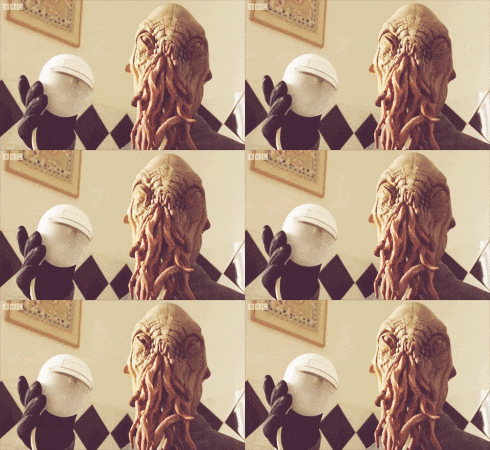
Doctor Who, Season 7 – Pond Life
Pond Life is the five-part minisode prequel to season 7.
It feels more like a practice version of the introduction to Rory and Amy’s domesticity in “Power of Three,” or perhaps the discarded rough drafts that ended up on the writer’s cutting room floor before the final script.
It was funny in moments — the Ood on the Loo, for example — which is a challenge in something so short and jam-packed with action. Also, Chibnall dropped so many names, planets, incursions in such a short amount of time, I can only assume he’s simultaneously setting us up for potential in-between adventures in Big Finish radio dramas or novelizations and doing a Classic Chibnall nod.
I would have liked an extra fight scene to point up the problems between Amy and Rory before ultimately arriving at a divorce, as we learn in “Asylum of the Daleks”. The way it is felt like everything was perfectly dandy and then out of absolutely nowhere, just for the convenience of the season 7 premiere, they split up. Wait…huh?
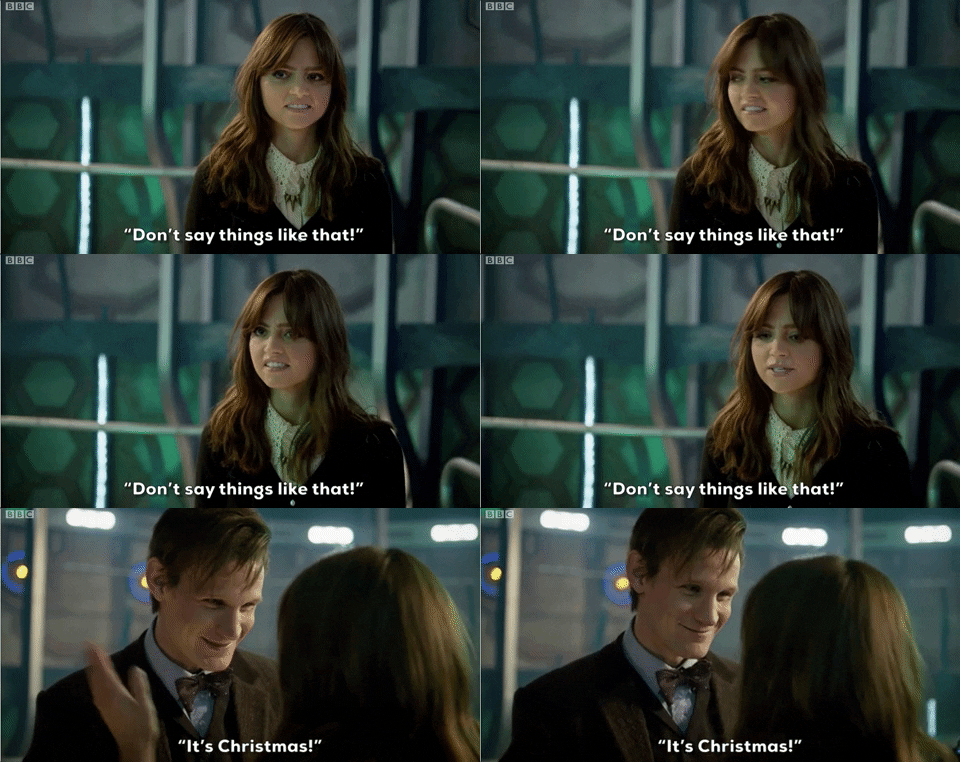
Another thing I’m noticing about Chibnall is how he makes the Doctor into a more sexual being than Time Lords may have been portrayed before, like in this scene with Mata Hari:
It’s also seen at the beginning of “Dinosaurs on a Spaceship”: the Doctor is accosted by Queen Nefertiti of Egypt. The way his voice goes up, her arm movements, and the comical folly horn coming from inside his pants pocket (it is his cell phone, technically), one can only imagine exactly what her hand is doing…
Doctor Who, Season 7, Episode 2 – “Dinosaurs on a Spaceship”
I mean, this is such a ridiculous episode. Like a former theater professor taught me, “Just because you can put Macbeth on the moon doesn’t mean you should.” I feel the same way about dinosaurs on a spaceship.
It was light and comedic, thankfully, because I’m not entirely sure the episode would have worked if it wasn’t actively trying to make fun of itself.
I also loved the Harry Potter nostalgic tone. With Filch (David Bradley) and Mr. Weasley (Mark Williams) in the same episode and two twin robots who reminded me all-too-much of a Space-George and Space-Fred Weasley. They were goofy and quippy and provided a welcome comedic ease.
Fun Fact alert! David Bradley, who played Solomon in this episode and Filch in the Harry Potter movies, also played the First Doctor in Doctor Who!
He came in The Sarah Jane Adventures story “Death of a Doctor,” in Doctor Who, Season 10, “The Doctor Falls,” and “Twice Upon a Time,” which is a finalist for The Hugo Awards.
Another round of bonus points for amazing one-liners!
"Rory Williams: Dad, I’m 31, I don’t have a Christmas list anymore."

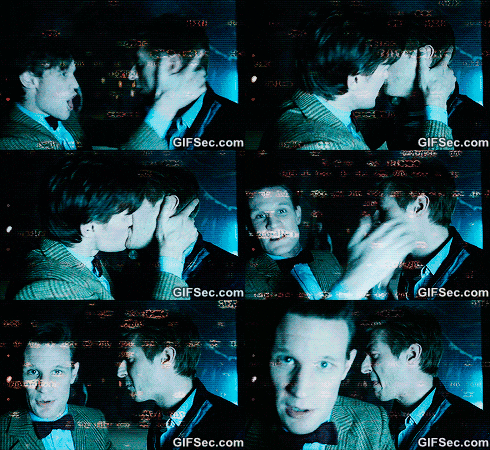
This is another Chibnall episode full of sexual innuendo. We already discussed the Queen Nefertiti moment when she put the moves on the Doctor in the opening scene, so we can breeze right by there. And you can check out the gif above showing the shared kiss between the Doctor and Rory. The last bit is the toilet humor when the Triceratops charges the Doctor, Rory, and Brian, sniffing at Brian’s trousers.
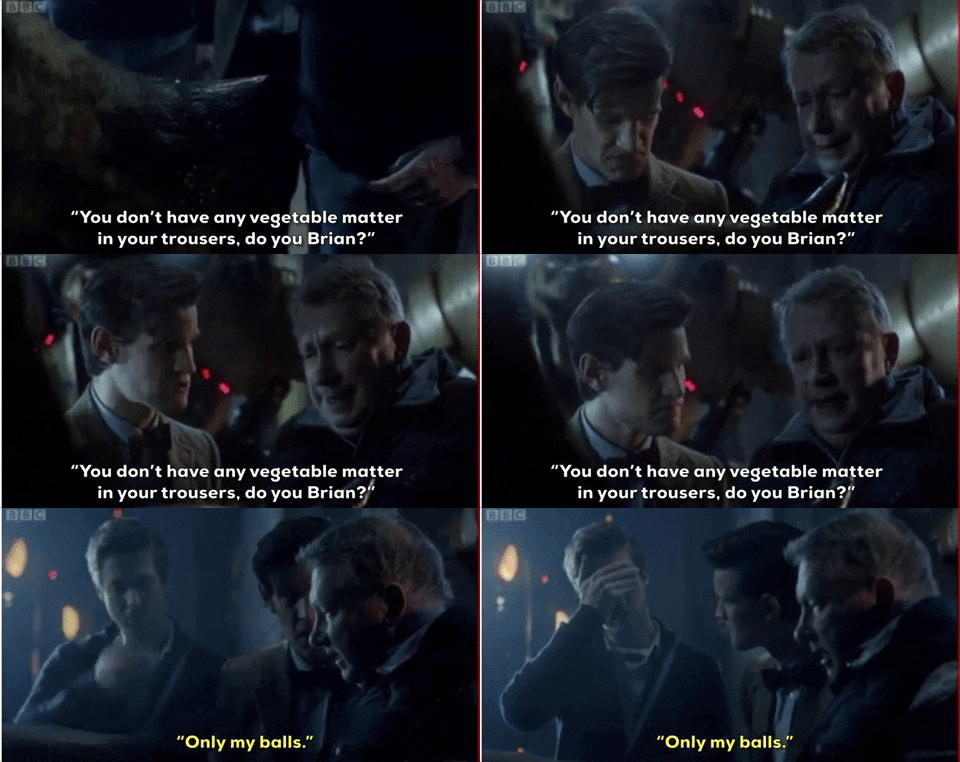
Us, too, Rory.
Where this episode won me over was with the back-and-forth between Queen Nefertiti (Riann Steele) and Riddell (Rupert Graves), the fact the top military leader is a woman of color, and all the fun domestic quips we get to witness when we get the Ponds altogether.
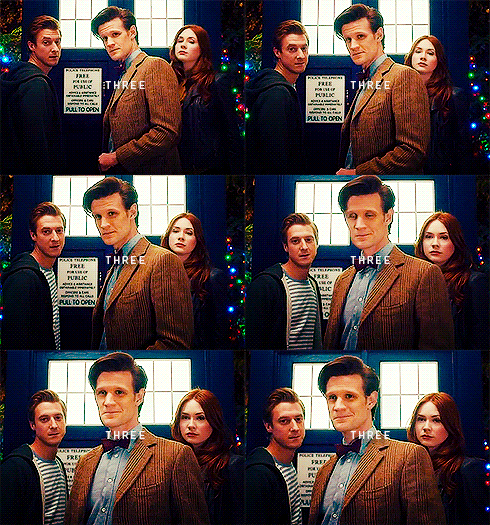
Doctor Who, Season 7, Episode 4 – “The Power of Three”
My biggest issue with this episode is the punchline. The last line of the episode only sort of makes sense — yet is spoken like it’s the most profound and proudest written moment.
According to Anglophenia, Chibnall based the story on the MSC Napoli shipwreck 11 years ago. The ship had a large collection of items aboard it, which washed up on shore in the coming months, and people grabbed the items and brought them home.
The idea that overnight, a city could be filled with little black boxes, like in this episode and people would pick them up and use them as paperweights, without knowing what they are, where they’re from, why they’re here … It seems more like a Black Mirror episode than anything else, to be honest. It’s chilling.
My second biggest issue with this episode was the way the set-up was so chilling–with people blindly taking in the cubes– but there was really no pay-off. The Shakri, as a monster, is interesting and has a lot of potential. A Gallifreyan children’s story turning out to be true!
It could have been a much more satisfying conversation between the Doctor and the Shakri, and I was disappointed when it came to light the Shakri’s main scheme is to “save the earth” by demolishing “the human plague,” which is a common storyline, and maybe a bit played out at this point.
I feel like it’s hard to talk about Chris Chibnall without mentioning Classic Who and the nods and secrets hidden in NuWho, and this episode was ripe with them. These moments are entertaining for anyone, but are an extra juicy bonus for the Classic Who fans.
The creation of Kate Stewart was a real fangirl moment for me. I had just finished watching the Third Doctor’s tenure when he was earthbound, working for UNIT under Brigadier Lethbridge-Stewart before this episode aired, and when they introduced Kate Stewart, I swear I welled up with tears of fangirling.
Best line bonus:
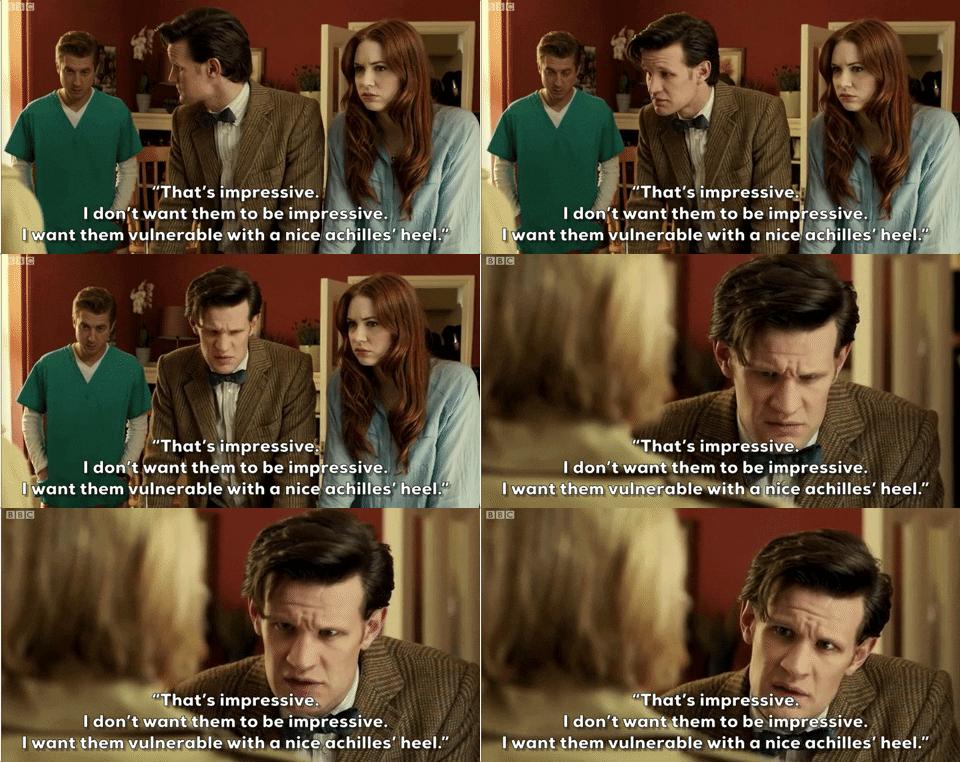
Chibnall also shows us in this episode that he really understands the Doctor. He understands the rhythm of his hearts, his hopes, his dreams, and his history. He has a few moments that show this, but the best way has to be this gorgeous speech, showing the depth of Chibnall’s love for the Doctor (and his magnificent ability to write poetry in lists, complete with some fab alliteration.):
“I’m not running away. But this is one corner of one country and one continent on one planet that’s a corner of a galaxy that’s a corner of the universe that is forever growing and shrinking and creating and destroying and never remaining the same for a single millisecond. and there is so much, so much to see, Amy. because it goes so fast.
I’m not running away from things. I’m running to them before they flare and fade forever. It’s all right. our lives won’t run the same. They can’t. One day, soon, maybe, you’ll stop.” (LIKE THE NEXT EPISODE, HOLD MY TEARS.)
Doctor Who, Season 7 – “P.S.”
This is arguably Chibnall’s most heartfelt work, in my opinion.
“PS” is an epilogue minisode that takes place after “Angels Take Manhattan” (season 7).
It was a scene written separately. Steven Moffat and Chris Chibnall never incorporated it into an episode and never filmed it, as Chibnall explains to Den of Geek below.
Chibnall wrote this scene while he was writing the “Pond Life” season 7 prequel mini-episodes (or “minisodes”; how fun is that word?). He talked about it to Den of Geek in 2013:
"“Steven [Moffat] knew how the Weeping Angels episode was going to end and we knew that Brian would come back in The Power of Three, and Steven was saying look, ‘I feel terrible, because I really want to finish off what happens to Brian but it just will not fit in Angels and it would feel really odd to put him in that’, and I just said, ‘Look, I’ll write a scene for the DVD’.”"
It was, however, animated storyboard-style and narrated by Arthur Darvill. Grab a kleenex before watching.
I discovered this episode one day while browsing Doctor Who YouTube fan videos, and I was not prepared. “PS” starts with the last scene in “Power of Three,” then the storyboard animation starts with a scene after “Angels Take Manhattan,” where we said goodbye to Amy and Rory.
The scene opens with Brian Williams, Rory’s father played by Mark Williams, watering the plants at his son’s house. This immediately gave me the ultimate feels because I realized no one had told Brian he’ll never see his children again.
In the episode that this epilogues, “Angels Take Manhattan,” Amy and Rory are targeted by the weeping angels, a species that feeds on potential time energy. With the touch of a stone finger, it zaps them back in time, forcing them to live out their days in the wrong era.
When that last scavenger angel zaps Rory and Amy back to the 1940s, we all cried with River Song, and we cried with the Doctor, but we never thought to cry with Brian. That thought just broke both my hearts.
A man shows up at Brian’s door with a letter and some effects, and Brian and we quickly realize it’s a letter from his son in the past, and what are these effects this strange man would have? Well, family albums, of course!
The fact Chibnall used the same convention Moffat did in season 4, “Blink,” having a descendent bring letters and family albums to their ancestor in the future (wibbly-wobbly, timey-wimey) didn’t bother me at all. It didn’t feel cheap or played out; it felt familiar and just-right.
I do wish they had been able to book Mark Williams to shoot this scene. It’s so moving and would only be made better if we had the depth with which Mark Williams presents in a scene.
Next: 7 best musical TV episodes of all-time
So, can Chris Chibnall pull off Doctor Who next season?
All in all, after examining these episodes more closely, I feel confident in Chris Chibnall’s ability as a poetic writer, a storyteller, and a fanboy of the series. All three of which are of the utmost importance to somebody like me, a relatively new fan, not completely accustomed to the grieving process during the change of the guard, as it were.
Steven Moffat moved mountains for me, and Chris Chibnall has big shoes to fill. I do, however, have faith and a little more trust that he will do so successfully.