What is Doctor Who?
What is Doctor Who? It’s actually more a question of “who” is Doctor Who.
He is an alien called a Time Lord from a planet called Gallifrey, but that’s not really the important bit.
He calls himself “The Doctor” and is an adventurer who just wants to see the universe.
He’s a brilliant, peaceful soul on a long-winded vacation who ends up finding and getting into trouble everywhere he goes.

The more important question to answer is why do I like Doctor Who?
I’ve already told you about how he saved me in a difficult time of my life, which you can read about here, but that’s not why I still watch Doctor Who.
The Doctor finds beauty and awe in everything he touches. One of the first things out of his mouth is “Oh, look at you! You’re beautiful!”

“Girl in the Fireplace” via GIPHY
He has a faith in humanity— a term I’m using loosely to define all species he comes across—that is unfaltering and ground-breaking. He is brilliant and brave, and not afraid of fear. This is a clip from “Listen” in season 8, with the Twelfth Doctor, played by Peter Capaldi:
But most of all, the best way for me to describe why I love Doctor Who so much is by quoting former showrunner Steven Moffat (and I must admit, I usually pull it up and pass my phone over because I can’t read this out loud without getting weepy.)
Steven Moffat on why heroes are important:
"“it’s difficult to talk about the importance of an imaginary hero. Heroes are important. Heroes tell us something about ourselves. History books tell us who we used to be. Documentaries tell us who we are now, but heroes tell us who we want to be. A lot of our heroes depress me. When they made this particular hero, they didn’t give him a gun They gave him a screwdriver to fix things. They didn’t give him a tank or a war ship or an x-wing fighter. They gave him a call box from which you can call for help. They didn’t give him a superpower or pointy ears or a heat ray. They gave him an extra heart. They gave him two hearts. And that’s an extraordinary thing. There will never come a time when we don’t need a hero like the Doctor.”"
Season 10, Episode One “The Pilot”
Welcome, New Whovians!
So either you want to get into Doctor Who or you want to get a friend into Doctor Who.
What a perfect time for you to do it, too! We are gearing up for season 11 with a new Doctor (Jodie Whittaker), three new companions, and a new showrunner.
You have T-minus 18 weeks to catch up. Let me tell you, you’ve clicked to the right place.
I’ll be your special curator for the day.

First things first: you don’t have to start from the beginning. Actually, I implore you not to start from the beginning.
Doctor Who generally follows the anthology model. The episodes are self-contained for the most part, and hardly any of them follow a general arc. There are certain episodes you can jump right into without needing to know anything about Doctor Who beforehand.
More from Doctor Who
- Doctor Who: The Power of the Doctor Recap
- Doctor Who season 12 finale recap: The Timeless Children
- Doctor Who season 12, episode 9 recap: Ascension of the Cybermen
- Doctor Who season 12, episode 8 recap: The Haunting of Villa Diodati
- Doctor Who season 12, episode 7 recap: Can You Hear Me?
Secondly, everybody is different. Each one of you is interested in different things, different genres, tones, styles, feels. Depending on your week, your mood, your personal history, I could curate a top-five list for each and every one of you individually. And trust me, I would love to.
Unfortunately, that’s not practical for an exercise like this.
What we’re going to do, instead, is discuss the top four episodes I recommend to strangers: people I meet in bars or at brunches, friendly gatherings and even curious strangers passing by who strike up a conversation.
Most of those in my circle would share that our first conversation was about my convincing them to start watching Doctor Who, preferably immediately and preferably with me.
The basic rules are thus: You try three episodes. If, after a careful conversation with yours truly, you still aren’t into it, that’s okay; maybe it’s not your thing. Fortunately for you, however, just like the neighborhoods of New York City, I believe there exists a corner of Doctor Who for everyone.
Regarding the classic series, which is defined by the serials aired between 1963-1989, unless you were raised on original Star Trek episodes and the sci-fi of old, start with NuWho. (Which means “the new series” that was revived in 2005 by Russell T. Davies.)
Once you fall in love, which I hope you do, then venture back to watch Classic Who (Bonus: if you do it between May 29-July 20th 2018, you can see it on Twitch! If not, I suggest BritBox.)
Quick lesson:
Let’s take a quick moment to explain the ever-changing faces of the Doctor and his blue police box. Time Lords have a special genetic ability that when they receive a fatal blow (like if they’re shot in the hearts), their bodies regenerate on a cellular level, rebuilding itself and thus saving their lives. Time Lords are normally given 12 regenerations—or 13 lives.

Sixth Doctor beginning regeneration in mini-episode “Night of the Doctor” via GIPHY

Ninth Doctor regenerating into Tenth Doctor in “The Parting of the Ways” via GIPHY

Tenth Doctor regenerating into Eleventh Doctor in “End of Time Part 2” via GIPHY
The blue police box is called the TARDIS, which stands for “Time and Relative Dimension in Space.” It’s the Doctor’s spaceship and time machine, and it’s bigger on the inside.
Are you ready?

Weeping Angel from season 3, episode 11 “Blink”
“Blink” Season 3, episode 11
“Life is short and you are hot” – Billy Shipton
‘Blink’ was originally a short story Steven Moffat wrote for the 2006 Doctor Who Annual, which he adapted into a full Doctor Who episode for season 3.
It barely features the Doctor, which is actually why I choose this episode as the first to watch. (Read it here).
Doctor Who can be confusing and overwhelming for new Whovians, especially those who aren’t already science-fiction-leaning. It can be over-stimulating, with the explosions and the robots, the science talk, and the very many references to older episodes, other characters.
When I start people on any other episode than ‘Blink,’ I end up getting a lot of “huh?” and “who’s that?” and “Wait—pause it real fast—.“
‘Blink’ is also a pretty-universal fan favorite. Of course, there are exceptions, but the majority of anybody I talk to will agree with me: ‘Blink’ is one of the best NuWho episodes.
Blink is maybe the best and scariest episode of television of all time and I think I say this every time I watch it. #DoctorWho
— Nicole L (@BklynNic) December 21, 2017
There are many genres of episodes within NuWho: super science-fiction, fantasy, romance, and horror. ‘Blink’ is like a mini horror movie. It gets back down to the true nature of what Doctor Who really was about: teaching and scaring little children.
Catching one of the best Doctor Who episodes ever on my break. "Blink" is perfect for Halloween! #DontBlink @DoctorWho_BBCA pic.twitter.com/SEYOTA53to
— Bill Blume, Lord of Chaos (@BillTheWildcat) November 1, 2016
"“The thing people never say about hiding behind the sofa, is that hiding behind the sofa is itself fun. It is a fun thing to do. Kids like being scared of Doctor Who. It doesn’t horrify them. It doesn’t petrify them. It is just an enjoyable thrill. There is nothing wrong with a bit of adrenaline.” – Steven Moffat, from Daily Mail."
‘Blink’ is perfect because it has a simple, yet powerful villain. A household name and face in Carey Mulligan, a bit of cheeky comedy, and a sweet love story.
It also eases us into the central conceit of time travel, using the relationship Sally Sparrow has with the Doctor as a catalyst to introduce us to the laws and rules of time within the confines of the
Doctor Who
universe.
talking about time travel via GIPHY
The villain is called a Weeping Angel. This is a species whose most notable defense mechanism is to turn to stone the moment anyone sets eyes on them. The Doctor calls this “Quantum Locked”.
When no one has eyes on them, they attack. They feed on potential energy; the way they attack is by sending you back in time and feeding on the potential years your life should have had. Here, the Doctor explains it better:
It’s poetic in the way only Steven Moffat pulls off.
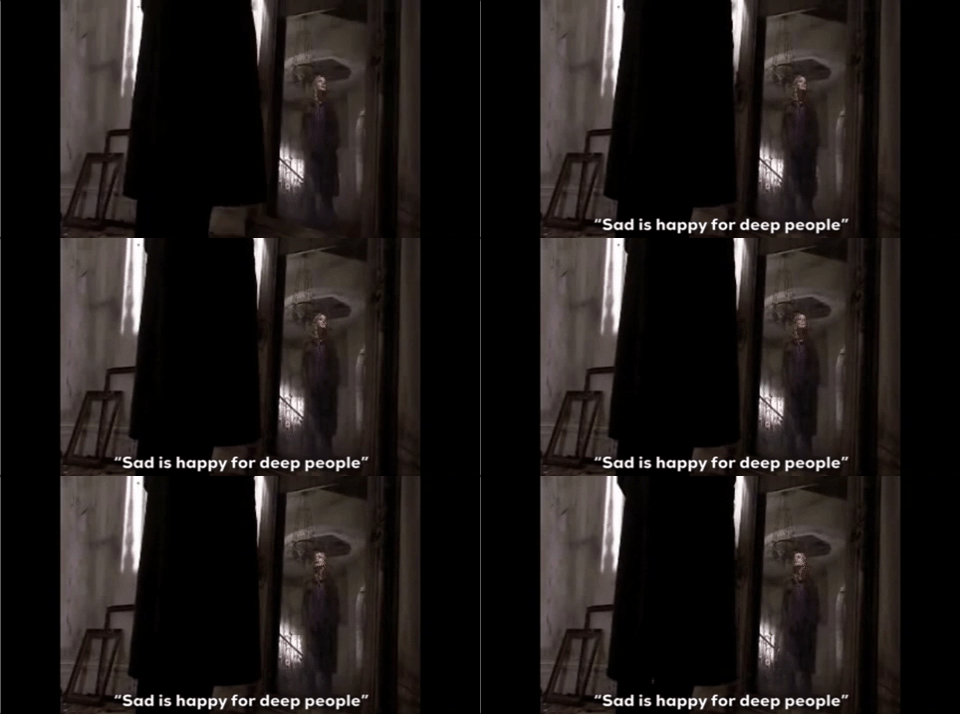
What’s most terrifying is no matter what statue you’re looking at, you don’t know if it’s a weeping angel. And you must not look away. You must not blink. (get it?)
“The Beast Below” The Eleventh Doctor and Amy
“The Beast Below” Season 5, episode 2
“You never interfere in the affairs of other peoples or planets, unless there’s children crying?” – Amy Pond
“Yes.” – The Doctor
This is a particularly good introductory episode because it’s one of companion Amy Pond’s first forays into the future in the TARDIS.
It’s episode two of a fresh Doctor: number Eleven, played by Matt Smith, and he takes Amy Pond (Karen Gillan) to a time after Earth has died, and the human population has taken to the stars.

They find “Starship UK,” a spaceship upon which Britain was built to survive past Earth. Of course, he runs into a mystery which must be solved, and Amy Pond helps him solve it…in her nightie.

We learn a lot about the Doctor in this episode. We are exposed to his ancient wisdom, how he is somebody who understands people at their base, in their habits, culture, and soul.
This is an episode that highlights his compassion in a lonely and deep way.
With Matt Smith’s Doctor — with Eleven– we get a glimpse into the way he thinks and how he feels in a way we hadn’t yet done.

He’s been a parent, a grandparent, a best friend, a lover, a leader, and he is alone in the universe. The last of the Time Lords.
This isn’t the first time we hear of this in the new series; it’s said in the first episode of the first season, but this moment is more poignant and ultimately more meaningful in the plot of the episode, as you’ll see when you watch it in full. (Spoilers!)

via GIPHY
There are two moments in this episode that brilliantly describe the entire point of the series. The Doctor gives Amy a directive to find the crying girl, and Amy responds:
"Amy: And what are you going to do? The Doctor: What I always do– stay out of trouble…badly. Then, she calls after him: Amy: So this is how it works, Doctor? You never interfere in the affairs of other peoples or planets, unless there’s children crying? The Doctor: Yes."
Quick Lesson:
The law of the Time Lords is that, as a species with time travel, they are not allowed to interfere with the events of history.
Way back when the Doctor was a young 450 years old, he stole the spaceship called the TARDIS and ran away from his people because he couldn’t abide by their laws of non-interference.
He couldn’t sit by, watching planets get scorched, people tortured, witnessing genocide.
“A moral dilemma is when your actions don’t line up with your values,” I think George Washington said that, or at least the character did in AMC’s brilliant mini-series Turn.
The Doctor had a moral dilemma, and so he stole the TARDIS and has been traveling ever since.

“The Power of Three” via GIPHY
Vincent van Gogh in “Vincent and the Doctor”
“Vincent and the Doctor” Season 5, episode 10
“In my experience, there is, surprisingly, always hope.” – the Doctor
What can I say about this episode? Ask any Whovian — name this episode, and you’ll receive a chorus of weepy sighs.
The Eleventh Doctor takes Amy Pond to a Vincent van Gogh exhibit at the Musée d’Orsay in Paris, where they find a monster painted into one of his pieces. Thus, the Doctor grabs Amy by the hand, and they run to the TARDIS to find this monster and save Vincent van Gogh.
This is a monumental episode for any art lovers or van Gogh lovers, rife with references to his life and his art. It brings his paintings to life as we step into his world.
Most importantly for me is how it shows mental illness in a de-stigmatized light. The way the museum curator, played by Bill Nighy, talks about van Gogh’s mental illness and subsequent suicide is poignant, yet non-judgmental. It shows Vincent in a state of despair, raw and vulnerable. It’s honest.
"The Doctor says to Amy, “This is risky.” Amy: Riskier than normal? The Doctor: Think about it. This is the middle of Vincent van Gogh’s greatest year of painting. If we’re not careful, the net result of our pleasant little trip will be the brutal murder of the greatest artist who ever lived. Half the pictures on the wall of the Musée d’Orsay will disappear, and it will be our fault."
The Doctor, too, corrects van Gogh’s language when he calls himself “mad,” explaining “depression is a very complicated—“ but Vincent stops him before he can finish his sentence..
My second favorite part of the episode (the first I can’t tell you because it’ll completely ruin the ending) is the fact the monster is invisible to everyone but Vincent. It’s real; it exists, but it’s invisible.
This is a poetic way to illustrate how certain people experience the universe differently from the rest. In the same way that no one person sees a color exactly like another, it yields to the idea that the lens through which creative souls perceive their environment is tangible and magnificent.
It gives the artists among us a romantic fantasy that helps us feel a little less abstract, a little more understood, and thus, grounded.
Clockwork Person and Rose, “Girl in the Fireplace”
“The Girl in the Fireplace” Season 2, episode 5
“Have you met the French? My GOD, they know how to party.” – The Doctor
Much like ‘Blink,’ this episode relies heavily on playing with time travel.
If time travel is something you generally have a hard time wrapping your head around, this is a good story to witness. It lays it out for you simply and talks you through it every step of the way, so don’t despair.
We start on a spaceship in the 51st century–a spaceship that happens to have time windows to the 18th century all over it, like portals that follow the life of one particular French aristocrat nicknamed Madame de Pompadour.
This is a fantastic episode to show you how the Doctor sometimes works separately from his companions; in this episode, Rose Tyler (Billie Piper) and her friend, Mickey Smith (Noel Clarke) .
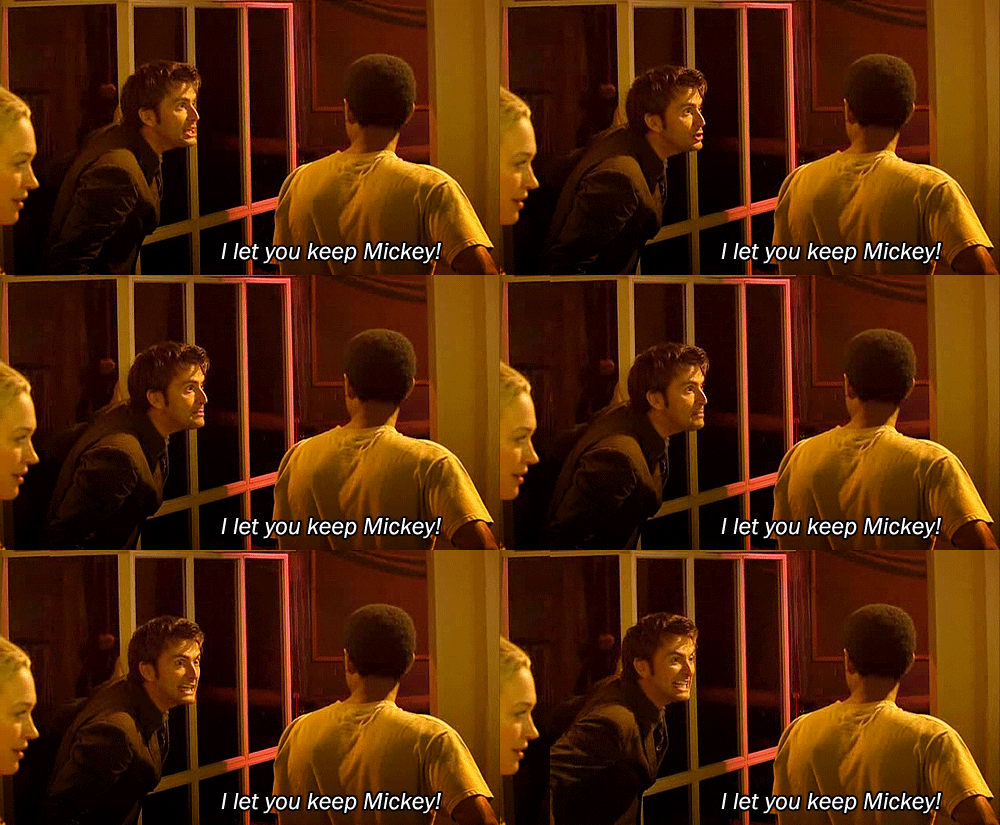
Rose has been traveling with the Doctor since season one, episode one by this point, so she’s able to show Mickey the ropes. Rose understands the culture of life with the Doctor, and Mickey understands the danger, which we see when Reinette drops the real truth here:

As the Doctor runs around figuring out what’s going on in the 18th century, on the spaceship side of the time windows, Mickey and Rose explore.
The companions are important to Doctor Who, as I’ve told you in here. They keep him grounded, keep him thinking. They present arguments and open his ancient, brilliant mind to what he would never think possible.
This was the episode when I fell in love with the Doctor in a romantic way. David Tennant brings such charm to the Doctor; he can be such a flirt. There is a kiss that I barely wish to give away here because it is well worth the viewing. (That kiss! I’ve had dreams about that kiss…)
But that kiss instigates a Doctor Pattern: he is stunned into silence and then, Boom!–epiphany! He realizes who she is and launches into one of his notorious quick-speaking monologues, see it here:
Favorite Line:
"Mickey: What’s a horse doing on a spaceship? The Doctor: Mickey! What’s pre-revolutionary France doing on a spaceship? Gain a little perspective."
Things we learn about the Doctor in this episode:
The TARDIS translates for you, even French!
"She was speaking French." -
— Sebastian (@buechermonster) March 29, 2015
"She was speaking English, I heard her." - "That's the Tardis, translates for you."
- "EVEN FRENCH??" XD #DW
The Doctor is a force to be reckoned with:
He can do a sort of Vulcan mind-mind type trick:

There we have it! A beginner’s guide to starting Doctor Who.
The best episodes to show his soul, his relationships with others, his badassery… The episodes that best introduce you to who he is and what’s important about the show as a whole.
“Blink” taught us about his reach through time, his influence on everything around him, while also gently guiding us through simple time travel.
“The Beast Below” is when we learn what it is to be alone in the universe and immensely kind.
“Vincent and the Doctor” shows how fixing one problem doesn’t necessarily fix all of them, but that doesn’t mean we don’t keep trying.
“The Girl in the Fireplace” demonstrates the depth of his love and, consequently, the depth of his hurt.
It is really difficult to dwindle it down to four stories, especially without talking with you all personally.
We haven’t even gotten into my favorite character, River Song: a fellow time-traveling companion who shows up once or twice a season.
Or “The Girl Who Waited,” from season 6, which is a beautifully tragic episode highlighting the love between Amy and Rory, the Eleventh Doctor’s companions.
I’d be remiss if I didn’t mention the two episodes written by my personal favorite author, poet, screenwriter, Renaissance man Neil Gaiman “The Doctor’s Wife” in season 6, and “Nightmare in Silver” in season 7. The first I can’t tell you about without completely spoiling it, and the second is a fun Cyberman revival episode set at an amusement park in space.
Wait, wait, I should stop– the whole point was to not overwhelm you, right?

Well, there will be other slideshows and other lists I can make for you, add to this list, and continue the journey together.
The Whoniverse is huge and at times overwhelming, even for me. It expands out to novelizations, podcasts, radio dramas, comic books, and museums.
Next: What you need to know about the new Doctor Who showrunner, Chris Chibnall
Most of all, it is filled with people who revere the Doctor for his compassion, his fairness, and his strength. We are a loving and welcoming group, and we will guide you through as best we can. Together.