

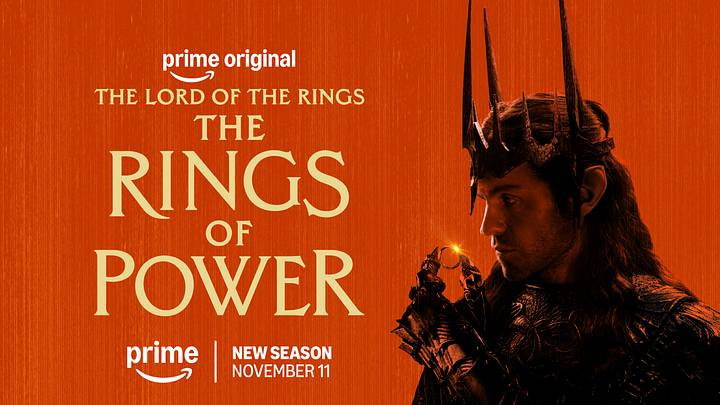
Set in the Second Age, The Lord of the Rings: The Rings of Power will show the rise of Sauron’s fortress, Barad-dûr, without simply copying Peter Jackson. Few pieces of fantasy architecture are as recognizable as Barad-dûr—J.R.R. Tolkien’s Dark Tower was the seat of Sauron, one of literature's best villains ever. Jackson’s movies turned it into a black silhouette crowned by a burning eye, but Amazon Prime Video’s series cannot simply borrow that image.
It has been confirmed that showrunners J.D. Payne and Patrick McKay can’t match their designs with the films’ for legal reasons, while they also want to honor Jackson’s legacy. With season 3 arriving on November 11, The Rings of Power has begun revealing how its production team approached the tower. Production designer Kristian Milsted provided a significant glimpse into Sauron’s Southlands abode, while only season 3’s release can confirm just how canonical the show’s tower is.
The camera goes inside Barad-dûr
The films only ever showed Barad-dûr from the outside. Season 3 of The Lord of the Rings: The Rings of Power is the first Tolkien adaptation to show the inside of Sauron’s fortress, and Milsted says it is the season’s most-used set.
The space works as a forge, a study, and a throne room. The throne is made from melted-down Elven helmets and armor from the siege of Eregion, with Milsted confirming that “Sauron likes to look good.” This unprecedented peek into Sauron’s private and professional life will give way to a dark tone for the season.
Barad-dûr stands at the foot of Mount Doom
In Jackson’s films, Barad-dûr sits in the middle of a valley. Milsted says the team “didn’t want to copy their approach,” and the version in The Lord of the Rings: The Rings of Power stands near the base of the volcano.
There is a narrative reason, too. According to Milsted, the design grew from the idea of harvesting magma power from Mount Doom (Orodruin) and channeling it into the tower’s forge, where Sauron works on the One Ring. Sauron forged the ring at the Cracks of Doom in Orodruin itself in Tolkien’s LotR novel, so it will be intriguing to see how the show parses this.
Celebrimbor haunts the halls
Sauron may have won in Eregion, but Celebrimbor still hangs over his new home. The Elven smith’s decomposing body is displayed in Sauron’s study like a trophy. The set was designed so the camera can move from Sauron at his desk to the body on the wall, emphasizing Sauron’s inner conflict. Celebrimbor will also seem occasionally somewhat alive through some kind of camera trickery.
The corpse mocks Sauron as he repeatedly fails to create the One Ring and perhaps provides a chance for him to reckon with his treatment of the Elf. The forge also recalls Celebrimbor, the Elf’s mark on Sauron, apparently profound. It imitates Celebrimbor’s own workshop from Eregion, reflecting Frodo’s idea in The Return of the King that evil can only copy and never create.
Fell beasts are allowed to climb all over it
In Jackson’s films, fell beasts are mostly seen in flight, swooping over battlefields and carrying the Nazgûl through the sky. Barad-dûr itself stays a still, towering backdrop. Season 3 appears to treat Sauron’s tower as a place where his creatures live, or at the very least, work. In the trailer, as Show Snob noted in its breakdown, a fell beast can be seen crawling down a balcony that resembles Barad-dûr.
The tower’s design would suit this. The production team made it appear built from cast volcanic rock and block stone, with no wood and minimal sorcery. The rugged, forked structure belongs to the landscape, and it offers plenty of surfaces for a winged monster to cling to.
The Eye of Sauron operates differently here
The iconic but non-canonical Eye of Sauron perpetuated by Jackson’s movies is absent here. Sauron’s Eye, in the texts, was largely metaphorical, representative of Sauron’s Orwellian gaze over Middle-earth. Amplified by his wizardry, Sauron’s insight penetrated far beyond mortal Man’s, serving his control.
The tower’s silhouette in season 3 is forked, inspired by Sauron’s jagged crown. This was reforged from Morgoth’s crown, as per Rings of Power season 2. The show wanted something unfamiliar in a crowded genre of fantasy towers, which works cleverly here, as it remains distinctly LotR. The Eye survives in a smaller form: an eye-shaped door opens onto a balcony from which Sauron can address his servants.
Final thoughts on Barad-dûr in The Lord of the Rings: The Rings of Power
For a series often accused of straying from Tolkien, The Rings of Power Barad-dûr looks like it incurs embellishment of the text rather than contradiction of it. Tolkien left the tower’s interior almost entirely to the imagination. So a forge, a study, and a trophy room fill gaps rather than overwriting canon.
Whether it works will come down to how it looks on screen. The first four episodes of season 3 premiere on November 11, when viewers will see whether Sauron’s tower lives up to the legend.
 Add us as a preferred source on Google