

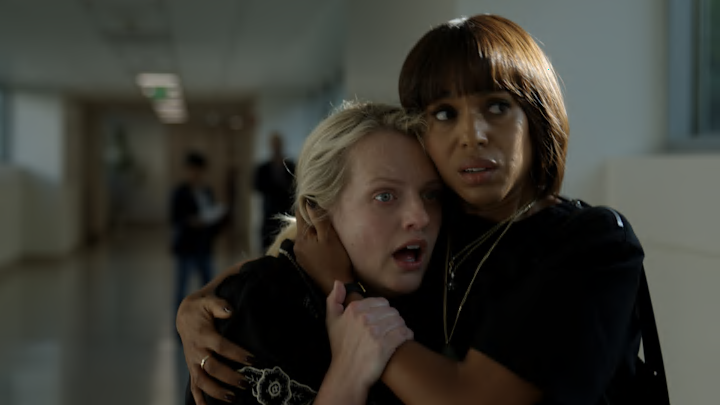
Imperfect Women, which may have started off feeling very similar to other shows featuring wealthy, secretive women, developed its own identity over the course of its season. While it never truly strayed from a fairly familiar nature, the Apple TV series does do the important work of portraying various points of view, with a select few episodes of the season being mostly told through the perspective of one of the main women, Eleanor, Mary, and Nancy.
Each perspective allows for a shift in motivation, intrigue, and unraveling the truth behind the messy relationships the women have with themselves, each other, and their significant others. Imperfect Women’s run certainly matches its title, as the main characters are most certainly flawed in various ways, a true acknowledgment of human nature. However, it can also be stated that Imperfect Women is less action-heavy and more of a character introspection. While there is certainly action among the episodes, as each woman confronts some form of danger to herself or from an outlying source, what Imperfect Women does more than anything else is explore the show’s two main questions: Who killed Nancy, and why?
Imperfect Women could have taken an easy way out after setting up various red herrings. After all, both Eleanor and Mary are suggested suspects for their own personal reasons, as is Robert, Nancy's widowed husband. Yet, it is the introduction of Scott Reed, Nancy's former stepfather and abuser, during Nancy’s flashback that sets up the idea that perhaps Nancy’s killer is not anyone who is directly involved in the main circle but someone from the past who has come back to bring about torture once again.
It is not until later on, though, that Imperfect Women unravels its true colors, which also means peeling back the dangerous layers of Mary’s husband, Howard, whose “good guy” persona is nothing but a mask to disguise his toxicity. Imperfect Women is filled with problematic characters, as no one gets to be the one character considered a more “morally good” individual. After all, everyone has something to answer for. But Imperfect Women’s slow unraveling of Howard to be the villain of Nancy’s story is mutually compelling and disturbing, mostly because it mirrors a world where a man like Howard is far too common a threat.
While Eleanor and Mary run around, desperate and determined to come to terms with and understand what really killed their best friend, Howard lies in wait, playing the role of a kind, if not slightly possessive, husband. That is, until the narrative actually shines a light on how dangerous he truly is. Once Howard’s real personality is uncovered, there is no going back, even when Imperfect Women wants to throw one last plot twist into the mix that suggests that Scott Reed was the actual murderer.
The Scott Reed twist is a punch to the gut when Eleanor and Mary are clearly at a loss as to how to move forward. The uncertainty surrounding Nancy's actual killer is a plot heavily shown as the series addresses bad police officers and detectives through conversations, but it never addresses the consequences of this. Eleanor and Mary tell the head detective, Detective Bethany Ganz, various times that they believe Howard is Nancy’s killer because of Howard’s affair with Nancy, as well as the ring that they found hidden among Howard’s things. Yet, the detective refuses to take their concerns seriously, staying tunnel-vision focused on a man who, while yes, they can prove was in the area, is still not someone whom they can prove actually killed Nancy.
Scott Reed is a guilty man for the assaults he performed on Nancy while she was a child, and he absolutely should face the consequences of his actions in sexually assaulting and abusing her. However, Detective Ganz looks the other way when presented with new theories and evidence, almost as if she wants it to be Scott Reed just so she can put the case to bed and not because she actually cares about who killed Nancy. Behavior like that from a detective is sloppy and dangerous and puts several innocent people in danger from the person who is capable of murder. How can Detective Ganz be trusted to fully follow up if she refuses to listen to those who were closest to the deceased?
Imperfect Women sets up its finale nicely, as Howard officially confirms that he did kill Nancy and has a final showdown with both Mary and Eleanor. Returning to the scene of the original crime is a nice touch and, in some ways, brings the story full circle. Nancy’s death receives justice in the exact place she was killed. But there are still a handful of things the season does not address or blindly skips over.
Where was the apology from Detective Ganz, whose negligence resulted in both Mary and Eleanor nearly dying at Howard’s hand? Considering how significant and emotionally poignant it was for Eleanor and Mary to directly confront Detective Ganz previously, only to be ignored, Imperfect Women could have benefited from Detective Ganz acknowledging her wrongdoings, even though it was not a main plot point.
The emotional build-up to Howard and Mary’s final confrontation works well, as it finally connects all the pieces of Mary and Howard’s destructive marriage, as well as Howard’s flaws as a human being, and shows how Mary and Eleanor’s connection and their love for Nancy are the things that help bring Howard down for good. Unfortunately, it is the aftermath of the final confrontation that is where things truly start to fall apart.
The final minutes of Imperfect Women are frustrating in their own right, mostly because they feel like a quick fix to answer remaining questions rather than actually giving Eleanor or Mary a true, substantial ending.
The flash-forward shows Eleanor on a boat, reunited with her brother and with a boyfriend of her own. The boyfriend is, of course, a random man who had never been introduced before, so it is hard to fully embrace the relationship between Eleanor and the nameless man she finds herself with at the conclusion of the show. What makes it more confusing is that Eleanor sees a notification on her phone reminding her of Mary’s child’s birthday party, an event she was likely supposed to be attending.
So, why was Eleanor on a boat when she knew there was a birthday party that same day, at roughly the same time? That makes no sense for the consistency of Eleanor and Mary’s friendship. Unless this moment was meant to represent that their friendship had faded away in the aftermath of discovering what had happened to Nancy and all the lies that had made their way into the trio's friendship. Still, if anything, the phone notification appears to be more of an excuse and reason to flash sideways to Mary at the birthday party, which is its own can of worms.
Mary’s appearance at the birthday party has her being joined by Robert as they celebrate the birthday together. Yet, while it is never directly stated, Imperfect Women’s finale suggests the possibility that something more than friendship may be bubbling between Mary and Robert, if it has not already. Granted, Mary and Robert would have a unique dynamic and trauma connection following knowing that their spouses had engaged in an affair that had led to a gruesome murder. However, Mary and Robert really have almost nothing to do with each other previous to the finale. Not to say that Eleanor ending up with Robert was the better ending.
The most significant scene that Mary and Robert share is when Mary directly tells Robert that she does not see what Eleanor and Nancy saw in him because he is not truly his own person at all but a shell of others’ expectations. While this may be the first time anyone has spoken to Robert in such a way, that does not necessarily mean that a potential romantic or sexual relationship between those characters actually would have been a benefit to the story’s ending.
Imperfect Women is not the most original series and may not even be the best in its own genre. However, the acting performances are strong, and the episodes themselves offer enough interest and character exploration to keep the viewer engaged and guessing. As a full season, there is a beginning, middle, and end that will not leave the audience accepting the closure the main story gives. Yet, it is the final moments that may leave viewers unsettled or unsatisfied.
 Add us as a preferred source on Google