

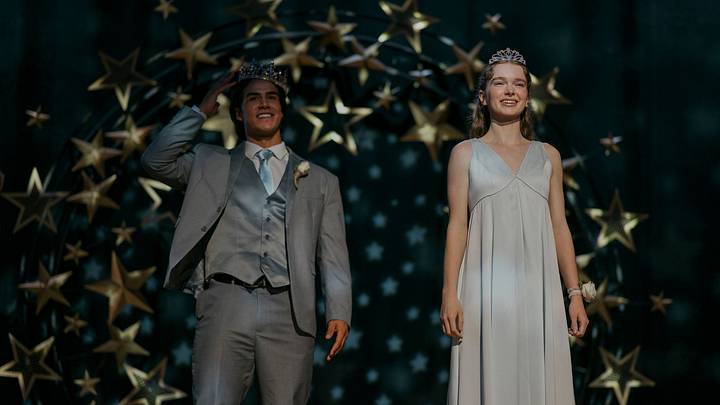
With Mike Flanagan’s new season-long take on Carrie having now debuted in totality on Amazon Prime, established fans of Stephen King’s iconic story and newcomers alike are flocking to the TV series. And while Flanagan’s show keeps many of the most centrally defining beats of the story, it also changes a great deal, partially out of artistic inspiration and partially out of necessity.
The original novel is less than 200 pages, and something like Brian De Palma’s 1976 film adaptation was able to cover most of the pertinent ground of the novel (though not all of it) in approximately 90 minutes. Thus, in order to stretch the story out to a full eight-episode run, Flanagan and co. sought to find ways to flesh out the story and ultimately came to some very different conclusions than any prior iterations.
One of the most interesting changes in the climax of the story, though, is an adaptation change that sees the series getting to have its cake and eat it too, in a unique way. Margaret White is a central character in every version of Carrie. She is Carrie’s mother and a primary antagonist of the story. Flanagan’s series makes some distinct changes to the characterization of Margaret White, primarily in updating her for the modern age and in giving the ever-phenomenal Samantha Sloyan the opportunity to really ramp up into the full-blown lunacy of something like Laurie Piper’s performance from De Palma’s film in a wholly different way. But in Margaret White’s death, Flanagan’s Carrie gets the best of both worlds.
In the new Carrie series, Margaret White comes face-to-face with Carrie for an intimate power struggle, in which Carrie uses her telekinetic abilities to fling multiple kitchen utensils at her mother before destroying their entire home. Yet even throughout all of this, Margaret survives, thanks in part to the revelation that she herself has repressed telekinetic powers that she uses to prevent the debris from crushing her entirely. Following this, Margaret is picked up and interviewed on-camera by the mysterious group of “shining” individuals, led by Kate Siegel’s character. They ask Margaret questions about Carrie, and when the matriarch begins to snap at them, Siegel uses her own telekinetic abilities to painstakingly slow Margaret’s heartrate until she is well and truly dead.
In doing this, Flanagan and his team were able to utilize both King’s original written death for the character and De Palma’s 1976 movie version, all while filtering it through a new lens. In King’s novel. Carrie kills her mother by using her telekinetic abilities to slow her heart rate when they come face-to-face in the White family home. However, when it came time to make the film adaptation, De Palma had his doubts about adapting this to the screen.
As screenwriter Lawrence D. Cohen recalled, “Brian felt strongly, and I think accurately, that the method in which she died in the book, with Carrie stopping her heart a little bit at a time was fantastic for the book and a really good concept, but in transferring it to the film, it really didn’t have any visceral punch or work at all… Brian came in, stopped at the table, and said, ‘I have a great idea about Margaret’s death. All the kitchen instruments are going to impale her.’”
Thus, the De Palma film ended with Carrie flinging various kitchen utensils at her mother and ultimately crucifying her into the exact same pose at the Saint Sebastian statue that Margaret has been forcing Carrie to pray to. Now, decades later, Flanagan has opted to both keep De Palma’s altered ending for the character and reincorporate King’s written ending for the character, all while utilizing it to build to a potential bold new future for Carrie.
 Add us as a preferred source on Google