

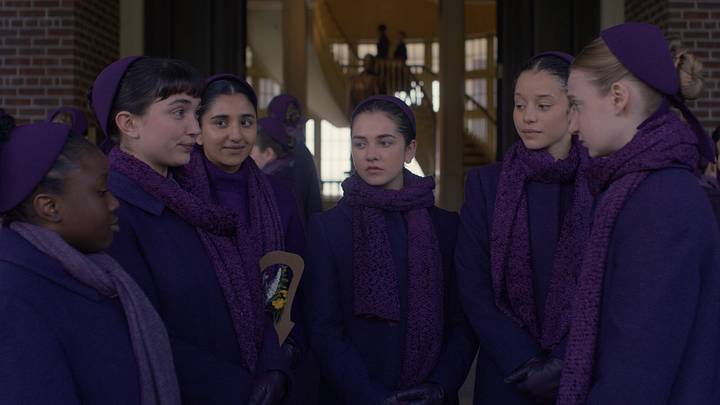
Following the climactic and equally frustrating conclusion of The Handmaid's Tale, its spinoff series, The Testaments, tells the story of a younger generation, one that grew up without the life experience of what the world was like before Gilead took over.
Focusing on June Osborn's daughter Hannah, or Agnes as she is referred to in The Testaments, the series follows a group of coming-of-age girls as they step out of childhood and reach the age of becoming Wives in Gilead society. With familiar characters such as Aunt Lydia and the rebellion group Mayday hiding in the shadows, The Testaments does not feel that far from its predecessor in tone. In fact, it beautifully portrays the horror of this society in the form of young women who can feel that something is not quite right, but don't have the life experience to truly do something about it.
Yet, season 1 works through this tone change by slowly but surely showing how each girl becomes more than aware of the unfairness and danger that they are surrounded by, even if they still do not quite grasp the lives they could have had if Gilead had never existed.
The Testaments features a well-rounded group of characters, as each episode gives a deeper insight into the slightly evolved version of Gilead that the show is set about four years following Boston's fall and separation from Gilead. None of the characters comes across as a copy-and-paste version of June, her fellow Handmaids, or Serena, Nick, Joseph, and Fred.
Instead, The Testaments does well to keep the tone of desire for revolution alive in Daisy without making her too much like June, as well as having Commanders, Wives, and Aunts without anyone coming across as being too similar to a pre-existing character. The Testaments certainly takes its shots at an intense approach, most notably when showing characters being hanged or losing limbs.
Yet, it is Aunt Lydia, the only series regular and concrete bridge to The Handmaid's Tale, that actively causes confusion, especially in her backstory episode, “The Stadium.” While The Handmaid's Tale originally suggested that Gilead's takeover was a slow burn of devastation before its inevitable usurping of the world that had once been, “The Stadium” suggests that Gilead took over in the span of one day, as flashbacks portray that all was fine until armed guards showed up, and that was the end of the world as they knew it.
Aunt Lydia, as a character, sits on the crossroads of original and spinoff in a way that the spinoff has not perfectly managed.
In The Handmaid's Tale, Lydia presents herself as a proud member of religious belief, and audiences spend countless episodes waiting on the edge of their seats, wondering if this is the moment that finally breaks Lydia out of her rose-colored glasses to see the truth of what Gilead really is, and what it has done to women.
However, The Testaments flips this mentality completely. Instead of a devoted follower, Lydia is revealed to be a cruel believer in survival at all costs. Potentially meant to make her appear more empathetic, this decision makes no sense for viewers of The Handmaid's Tale, who now have to flip their entire view of Lydia's actions and motivations from the first moment she is introduced.
By the conclusion of season 1, it is Agnes' best friend, Becka, who ends up being a standout character. She certainly makes an impression throughout the season as the one main character with no interest in marriage. Yet, it is Becka's actions toward the end of the season, following her realization that her father was assaulting Agnes and her other friends, that allow Becka to do something that can not be undone, in a shocking but enthusiastic display of stepping into one's own power and realization of what they can, or will not, accept.
The season finale, “Secateurs,” takes everything that every episode thus far has built up to and places it under the microscope when considering stakes. June, who has appeared in a few episodes throughout the first season, has had an intriguing mirroring dynamic with Daisy that is finally put on full display as June is confronted by a teenage girl who shares her desire for justice, freedom, and rebellion.
“Secateurs” also finally addresses the question of whether Daisy’s arrival in Gilead beside Agnes was a purposeful placement or a nearly impossible coincidence. June’s desire to see her daughter free still remains an integral part of June’s arc, even after all these years have passed. Daisy’s interactions with Agnes are the closest June has had in years, and Daisy’s offerings of who Agnes is growing up to be finally offer June some sort of comfort in learning more about her daughter, even if June is still in a position where she still cannot help Agnes get out of Gilead.
Of course, The Testaments could not end its first season without dropping the big bomb on Agnes, confirming the identity of her biological mother, as well as finally having Agnes and Aunt Lydia directly acknowledge the connection.
Overall, The Testaments showed itself to be a worthy sequel to the original series. There are still plenty of questions that its upcoming second season must confront, such as who Agnes becomes now knowing her roots, how Daisy works to unravel Gilead’s hold on her newfound friends, and what will become of Becka now that she has followed through with marriage, the one thing she desired to avoid at all costs. The Testaments follows through with the same focus as The Handmaid’s Tale in crafting several young women to root for in fighting against Gilead’s regime.
 Add us as a preferred source on Google