

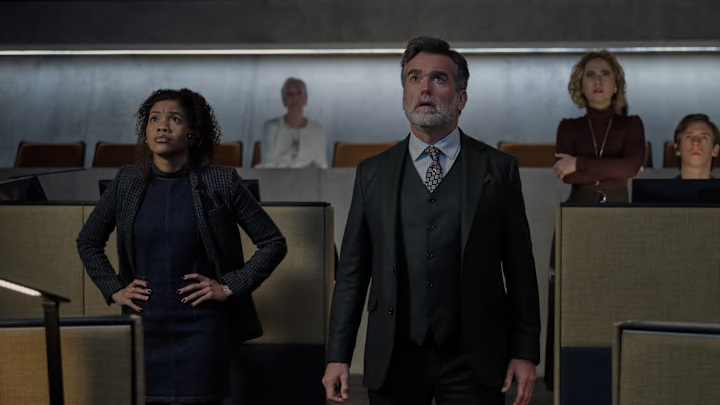
Peacock is ending the year with an epic spy thriller, The Copenhagen Test. It brings a mixture of everything you love about traditional spy thrillers, and throws in some sci-fi elements to make you stop and think a little deeper.
Sinclair Daniel and Mark O’Brien play Parker and Cobb, respectively. They both work for the same agency as Simu Liu’s Alexander, but not quite in the same roles. As one knows more than the other, it leads to plenty of mystery and intrigue throughout the first season.
We chatted with the two of them about their roles and what they love about this new spy thriller.
Let’s jump straight in with what it’s about the characters of Parker and Cobb that you knew you had to play them.
Mark O’Brien: For me, Cobb was just a conflicted character, and I think you want to play characters who are up against something, they have a Goliath they have to face in some sort of way. When he notices that something is off here, there’s a battle he has to take on, and it’s something that he’s not really equipped to do. That’s just a great thing to play as an actor. You want conflict, you want problems, and the problems on the show is constant. I was super drawn to that.
Sinclair Daniel: Yeah, I’d say similarly, there’s the challenge aspect of it. Parker has one of the more interesting challenges before her: to study somebody she’s never met and learn him so well that she has to predict his every move. That’s not an everyday audition that comes across your desk, so I thought it was super cool, and I really wanted to figure that out with her.

Parker is such an intuitive character. She’s able to go, ‘Hang on, what if…Let’s hold it…’ What was that like to prep for and adapt into The Copenhagen Test?
SD: I think as far as prep went, I prepped in the way I think Parker would have prepped, which was just diligent notetaking and making sure that I understood where Alexander’s story was going as well as Parker’s. When I was reading the scripts, trying to, you know, he’s got panic attacks throughout this season, and his family is a big element, and so I’m sure Simu was doing all of that work, highlighting and underlining when major life events for him happened, because that’s something that I would need to know.
Mark, with Cobb, he is so candid. There’s a moment in the first episode that I did laugh out loud at, when Simu is like, ‘Yeah, thanks for being honest about it.’ What’s that like to bring the realism to the screen?
MO: I think you have to be aware when you’re doing something like that, that it is funny, but you don’t play into it in any kind of way. There’s a part of Cobb that he’s not aware of, and there are so many times where people are like, ‘You should just keep your mouth shut.’ I love playing that. It’s great to play a character who is having an effect on the other characters. That’s so important.
It’s tough to play a role where it’s like, ‘Here’s the file, Sir.’ You want something that is creating an effect, and you’re saying things that maybe you shouldn’t. And he learns, throughout the series, he’s learning more and more. He’s more comfortable, and he’s more in control, and he’s learned a lot in a short period of time. I think he’s learned more in that part of time than his whole life up to that point, due to what’s happening.

How much of your storylines did you know from early on, and how much did you find out as the scripts came in?
SD: I think at the very beginning, when I was offered the job, I think I only had read two episodes. Then after I got to Toronto, two more came out, and then beyond that, they were in process while we were beginning to shoot. It kind of came out in sequence, so we didn’t really know how it was going to end.
MO: I actually got all of them, and they told me all about your character before.
SD: That’s so interesting. I wish you’d have let me know.
MO: No, it was the same for me. Every show is different in how they do that. I find that a lot of the time this is the case.
How does it inform how you play the role as you’re going on with each episode?
Massively. It’s interesting because in a movie, this is what it is, and maybe that movie was written 10 years ago, and they’ve been trying to get it made. What’s cool about a TV show like this is that as you are performing the first two episodes, the creators might see that, and it’s like, ‘That was really good. Let’s lean into that.’
I’m not saying that was the case on The Copenhagen Test, but you’re kind of informing one another slightly, and the way the characters interact. Sinclair and Melissa [Barrera] are really good together. I’m not saying that’s what the writers did, but I do think that there is something happening that really, that’s really like a copacetic thing happening throughout the series, where everyone’s informing everyone else.
And so, learning more about yourself, you may even put that forward a little bit in what you’re doing, or what you’re not doing. It didn’t really work, or who knows. I don’t know how the writers do it, but I do think that it was a really organic part of the process. That’s cool when it occurs, so it’s not as rigid as a film.
The interview has been edited for clarity and length.
The Copenhagen Test drops as a binge-watch on Saturday, Dec. 27 on Peacock.
 Add us as a preferred source on Google