

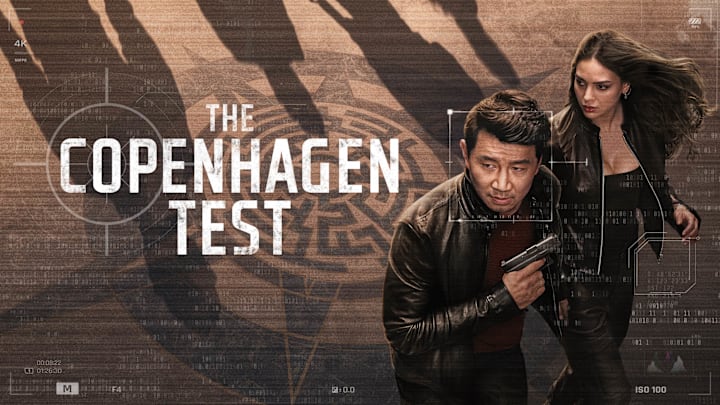
Peacock is ending the year strong with a sci-fi thriller that you will not want to miss out on. The Copenhagen Test brings us a tale of a first-generation Chinese-American man who wants to do everything he can to prove that he is loyal to his country. When his eyes and ears are hacked by an unknown entity, government secrets could be spilled, but is he a traitor?
Thomas Brandon created the series and is co-showrunner along with Jennifer Yale. The two sat down with us at Show Snob to talk all about the upcoming series, which drops as a binge-watch on Peacock on Saturday, Dec. 27.
The two chatted all about the initial conception of the show, but there’s also an important topic of getting the experience of a first-generation American right. And that is different for everyone, so Brandon and Yale did one thing that would help to bring the right voice forward.

Show Snob: Let’s start with the conception and inspirations for The Copenhagen Test, and how long did it take?
Thomas Brandon: It took a while. I first had this idea in 2017, and it had been percolating for a while, just a mix of a couple of different genres and inspirations. One was my deep love of spy novels, Cold War paranoia, all of that tactile stuff. Then I had a laptop that was hacked by people who were using ransomware, and as a writer, I envisioned, ‘Okay, if I’m afraid of this right now, my phone’s been hacked and my webcam, what’s next? What could be the next step five years in the future?
And I started thinking about your eyes and ear being hacked, and then that started marrying with the idea of someone who works in an intelligence agency not realizing they’re compromising top secret documents. Then the final piece was my love of ‘90s cinema, and I realized that if you keep the hack open, you’re creating a Truman Show world, which is one of my favorite movies. There’s this guy who is going to have to figure out what is real and what is not in his own life. His entire life is the mission, and everything becomes about us trying to figure out what the actual story is being told, and who it’s being told for.
There are so many spy thrillers that will get bogged down in the mystery, but yours doesn’t. I’m hooked immediately. So, how did you go about making sure it was thrilling and interesting and not [overwhelming]?
Jennifer Yale: We really looked at the show as this puzzle box, but in doing so, we wanted to not just exhilarate the audience, but also not exhaust them at the same time. To, there’s a push and pull of making sure that if we had scenes that were paranoia-filled or thrilling, like what you were just describing, that we would also follow it up with a scene that was calmer that would allow the audience to breathe, before we threw them into the spiral again.
It needs to be part of the viewing of the show. Sometimes they were ahead of Alexander, and sometimes they’re not. Sometimes, he knew more than they did. But a lot of the time, they’re with him in figuring out who to trust, and who’s lying and who’s telling the truth, and who’s actually helping him or using him.

TB: And there are a lot of intricate, thought-provoking parts of the show, but one of the things we talked about is, like in ER or The Bear, some of these characters who have the specialized nozzles speak really quickly. I don’t know what they’re talking about, but I know what they’re saying. I know what they want.
That was a big thing for us is following the characters and what they want and how they feel about what’s happening to them. If you can lock into that, then you can get through a lot of mystery and still hold onto what the show is actually about.
You have a beautiful touch on what it’s like as a first-generation American. What did you do to hone in on that and be true to the experiences?
TB: That’s a great question. There’s a William Faulkner quote, and he’s just a paragon of racial understanding and justice, and he said, in order to write something that wasn’t his own, he needed three things: experience, imagination, and research, and he needed two of the three. One of the things that I very much did not have was experience. I’m not a first-generation American. I’m not the child of immigrants, but I knew that this story would have a different resonance if it were placed upon somebody who was constantly having to prove something that I’ve never had to prove, and I knew that was interesting.
I knew that was going to tell us more about what it’s like to be American than any other kind of story, so I had to do a lot of research. I got really involved, and I had my imagination. And the one quote that I’ll pin to Mr. Faulkner is that you can do that, and then you need to check and see how close you got, and Jen was a real help, and she can speak for herself.
Also, our executive producers, James Wan, and then Simu [Liu] came on board, each having different perspectives and different kinds of families. It’s not a big monolith, so you can do the really hard work, and then you see if it’s ringing true. How is this authentic?

JY: We also filled our writer’s room with first-generation Americans who were from all over, and it’s the idea that everyone one of us has a different story. But a lot of the time, for people who don’t look truly like an American, it doesn’t matter how much success you can have or that you were born and raised here. There are many times that you’re still asked, ‘What is your country of origin?’ as if you don’t belong.
It was something that I think we talked about and made sure that we always had that part of the heart of the show, and how much of the character of Alexander just wanted to prove that he not just belonged here, but that he loved his country and was willing to fight for it.
This interview has been edited for clarity and length.
You can check out the full video interview for The Copenhagen Test below:
The Copenhagen Test will debut on Peacock on Saturday, Dec. 27 with all eight episodes dropping.
 Add us as a preferred source on Google