

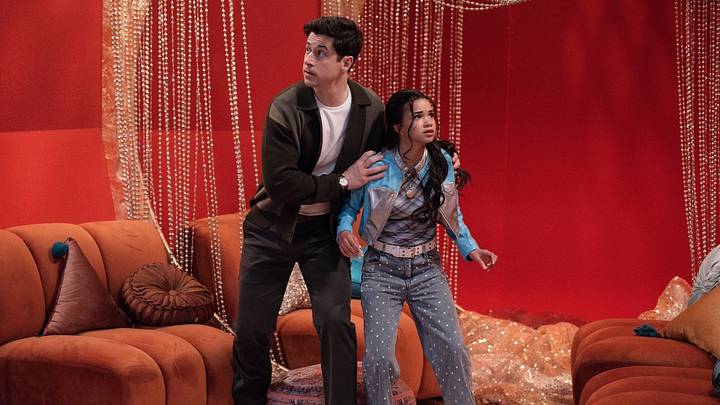
The four-part finale event of Wizards Beyond Waverly Place had the opportunity to tie up loose ends, offer grand reunions, celebrate the series itself, and recognize the significance of the show that came before it. While the final four episodes do tie up the loose ends of Billie's story, Wizards Beyond Waverly Place, sadly, is more likely to be remembered for how it completely disrespects the original series and characters more so than anything it does for Billie, Milo, Roman, or Winter.
The four-part event focuses primarily on Billie's desire to reunite with her parents, Alex and Damien, while Justin plays a role in helping the reunion happen. All the while, the final season's main villain, Lord Morsus, lies in wait. It is a final season that could have had potential. Instead, it spits in the face of everything fans of the original series had known and loved about their beloved favorite characters and what they would have wanted, or expected, to see from them.
Perhaps the most polarizing decision of them all was the choice to reveal that at some point between Wizards of Waverly Place and Wizards Beyond Waverly Place, Mason had died. Mason was Alex's most significant love interest, appearing several times over the course of the third and fourth seasons of the original series. The plot twist that Mason was a werewolf helped build lore into the show while allowing for Alex to avoid having to keep wizardry a secret from him. The dynamic, over time, became troublesome, as the two were broken up before coming back together before the show ended. However, the choice to kill Mason is only part of the problem here. The other part lies in how Alex's life would have played out afterward.
Based on the already established understanding that Alex would have given birth to Billie when she was 19 years old, that means that Mason likely died fairly soon after the events of The Wizards Return: Alex vs. Alex, in order for Mason to be absent and for Alex to have met Damien, married him, and given birth to Billie within a span of one year. Alex and Mason's relationship was never perfect, but the suggestion that Alex moved on from Mason's death that quickly is completely out of character, as is the idea that Alex would have considered herself mature enough at 19 years old to raise a child.
Wizards Beyond Waverly Place had already established that Mason was not the father of Alex's daughter, and that could have been easily explained by stating that they had broken up. After all, Wizards of Waverly Place showed Mason having jealousy issues, and Wizards Beyond Waverly Place could have leaned into that side of Mason's personality to explain why he and Alex had ended their relationship. After all, it would not be the first time that Mason jumping to conclusions or allowing jealousy to get the better of him would have resulted in a break-up between him and Alex. Besides, the idea of Alex moving on from Mason after a breakup is more plausible and far less tragic, devastating, and out of character than Alex moving on from Mason so fast after his death and falling in love with someone else, no matter who the other person was.
Jennifer Stone's return as Harper Finkle is fun, joyful, and brings back one of the only feelings of familiarity the final season brings, especially when seeing her chemistry with Selena Gomez play out. Unfortunately, the narrative fails Harper as well.
Alex's reunion with Harper only appears in what is revealed to be an alternate reality within Alex's mind, which means the person Alex is interacting with is not the real Harper. The implication of Alex and Harper's reunion suggests that they have not spoken or been close in a while, a decision that drastically goes against the tight-knit nature of Alex and Harper's friendship. While it is realistic that people who are close as kids and teenagers may grow apart as adults, there is never actually a definitive explanation for the state of Alex and Harper's friendship, other than the alternate Harper asking Alex to call her.
After returning home, Alex never mentions Harper at all, and to a degree, it is like the entire scene never happened in the first place. So, where is Harper now? By the rules of the original Wizards of Waverly Place, Harper should be getting ready to write the H.J. Darling novels and preparing to be sent back to the past. Yet, the series of events that led to that has not happened either; more specifically, the reveal to the world that wizards and magic are real. While Wizards Beyond Waverly Place brings back a familiar version of Harper, it does not answer questions about who she is now, what she is doing, and how she continues to fit in with the Russos, as she was an honorary Russo family member.
The final original character to make an appearance in the finale event is Theresa Russo in a limited role that features perhaps the best reference to the original series. Theresa's return is mostly a play on how she can always tell when Alex is lying to her. After all, Theresa spent the entire original show watching Alex, Max, and Justin perform magical chaos. So, she is more than used to knowing when something is up, even if she does not know what it is.
While she initially appears briefly on screen during a FaceTime call, the real reference comes much later, when the Russo family is confronted, yet again, by Lord Morsus. Theresa appears, iconic lamp in hand, and hits Lord Morsus over the head with it, only to place it on the table and knock it off herself just moments later. This is one of the greatest references to the original series and one of the main ones that feels like a legitimate callback for longtime fans who enjoyed the running gag that this one lamp in particular would always fall to some sort of destruction, no matter what.
But, of course, there were select characters who were notably missing from the final episodes, such as Jerry and Max. While Jerry had guest starred in two episodes previously, Max never appears at all over the course of the show's three seasons. These choices, especially in the four-part finale event, are mind-boggling, especially when considering the conclusion of season 2. Alex's jump into the rift leaves several questions about where she went and how long it will take to get her back. This seems like the exact type of thing that a person would contact their family to inform them of, whether it be to ask for help or to just let them know. Instead, Justin keeps the entire incident a secret for seemingly no reason other than to explain why none of the rest of the Russo family comes rushing to help and be present for the entire final season. Justin does not even mention having spoken to Max or Harper on the phone about Alex's sacrificial move.
Regardless of the reasons why Max did not appear in the episodes, the least the show could have done was reference whether he was helping look for ways to find Alex off-screen. Instead, by leaving him out again, it results in Max not being viewed as integral to the Russo family, even though he was one of the most important characters in the original series. Max had already been shown as not being as connected to the family, but Wizards Beyond Waverly Place, in its refusal to acknowledge the character at all during the final episodes, reinforces this idea that he would not be important enough to even be told that his sister was missing.
While Max and Justin did not always see eye-to-eye, Justin and Alex have both mentioned speaking to Max in previous episodes, and one of the biggest charms of the original series was seeing the three Russo siblings, Alex, Justin, and Max, work together. As for Jerry, his absence is explained, albeit briefly, but it is enough to explain why he is not present. Still, given the narrative stakes, it is not necessarily the strongest way to explain the absence of a major original character when his daughter has jumped into a magical void.
The final scene, which features the Russos in the Waverly Substation, is a nice callback to where it all began. But its attempt to end the show on the familiar topic of who will win the Russo Family Wizard Competition also brings up several questions about what that actually means now for Billie, Roman, and Milo. Billie is Roman and Milo's cousin and is back living with Alex and Damien full time. Based on the rules of the original show, the Family Wizard Competition would be limited to Roman and Milo, who live in the same house, even though Justin teaches all three of them. Why wouldn't Billie, as an only child, get to grow up keeping her powers and become a full wizard? The conclusion makes it seem as though Billie will still be competing against Milo and Roman, even though at no previous point in the original series did it seem like that was how the competition worked.
Overall, Wizards Beyond Waverly Place, on its own, does not live up to Wizards of Waverly Place in its writing or chemistry. While it does work as a family-centric show about being there for each other no matter what, in terms of its connection to Wizards of Waverly Place, this sequel series lets it down on almost every front. Wizards Beyond Waverly Place ignores and disregards some of the original's most important lore.
At no point does this show explain or justify how Justin is allowed to keep his powers while being married to a mortal, something that was an integral part of Jerry's view of magic and his family in the original Wizards of Waverly Place. It was part of the key to understanding what Jerry was willing to give up to be with Theresa and an integral part of the inner workings of the aftermath of Alex's wish-gone-awry in Wizards of Waverly Place: The Movie. Trying to force events into a timeline that just does not work hurts both Alex and Justin's lives by trying to stuff a significant amount of trauma for both of them into a small window of time while then aiming to explain how everything would have worked out so quickly afterward. Justin's timeline between starting his job as the Headmaster of Wiztech, only to lose it a year later; breaking up with Juliet so quickly; and meeting and marrying Giada all happens far too fast for the timing that the show explains and offers.
How are Justin and Giada celebrating their fifteenth wedding anniversary when Justin is 34 years old at the beginning of the show? That would mean Justin met Giada before he even started working at Wiztech, as Justin is already at least 19 years old in the series finale of Wizards of Waverly Place. While Justin clearly sees Giada as being the love of his life, that does not explain how he got over his break-up with Juliet so quickly, as he would have needed to in order for this timeline to work.
Meanwhile, Alex's life between Mason's death and meeting Damien must have gone so fast it would give anyone whiplash in order for Alex to grieve and fall in love with someone else in such a short amount of time while also dealing with the emotional aftermath of becoming pregnant. Harper's return also plays into her old crush on Justin. But is that only there because it is a sticking point in Alex's subconscious? Or is that meant to play specifically to the audience who called out the irony of Justin marrying a woman who had red hair but was not Harper?
Ironically, Max, who was revealed to have successfully transformed the Waverly Substation into a popular sandwich shop franchise, may have been the only character to escape the spinoff without confusing harm being done to the character. Max is rich. He lives on a yacht. While his absence is noticeable, it also prevented the spinoff from pulling the rug out from underneath him in the way it alters Justin, Alex, and Mason's lives.
Wizards Beyond Waverly Place may have worked if it had been its own, individual series about a young teenage girl with a prophecy hanging over her head while magic runs wild. There was certainly potential for the concept of a show for these characters that would have allowed them to shine had it not been attached to an already established, popular, and beloved series. But, with how Wizards Beyond Waverly Place handled the returns, or absences, of its original characters, rather than being celebrated, Wizards Beyond Waverly Place will become known as a story of what not to do when developing a revival or sequel spinoff series.
The original characters and storylines are to be celebrated and intertwined in ways that do not harm or destroy what fans had once loved about them. While Wizards Beyond Waverly Place could never truly kill the legacy that was left behind with the conclusion of the original Wizards of Waverly Place, it is an ending that shows that some shows are better left alone when their run comes to a natural end.
 Add us as a preferred source on Google