

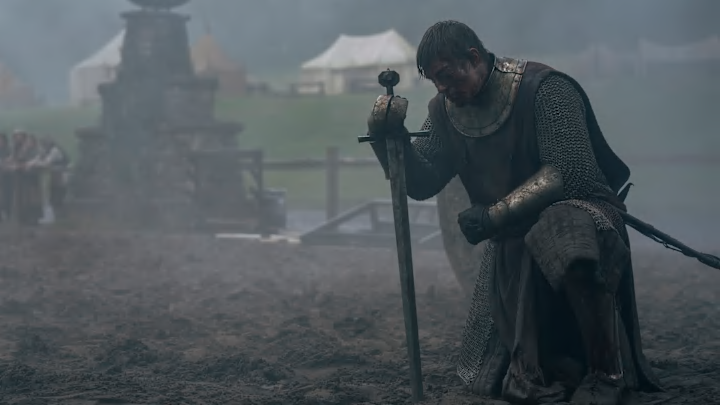
Thanks to such mythical creatures as dragons and White Walkers, Game of Thrones was famous for its many magical elements. Of course, its first spinoff show in House of the Dragon is almost entirely based around the affairs of its menacing titular creatures, but with A Knight of the Seven Kingdoms, magic and dragons are notably omitted.
Most fans are aware that White Walkers have yet to make their resurgence at this point in the timeline, and dragons have been extinct since the infamous Dance of Dragons, which takes place in House of the Dragon, but of course, other forms of magic in A Song of Ice and Fire could have been easily implemented.
There are many forms of magic in A Song of Ice and Fire

In regard to Game of Thrones, there are many types of magic that fans get to see. There’s the blood magic of Melisandre, also known as The Red Woman, along with the skin-changing of Bran. Green sight could also be delineated with regard to the latter character, while Melisandre also boasts divination powers, as shown with her visions in the fire.
Plenty of people are resurrected in the original Game of Thrones, mostly thanks to Thoros of Myr, as he saves the one-eyed Beric Dondarrion. In season 6, it's revealed that Melisandre is also capable of bringing the dead back to life, rendering her among the most powerful characters the franchise has ever had to offer.
None of this even mentions Melisandre's use of glamours, wearing a ruby necklace that conceals her true appearance. Many of these magical types are expanded upon in the books, showing how much potential these spinoff shows have to display fantastical elements.
There were also warlocks in Qarth and the Faceless Men in Braavos, those figures being featured in Daenerys and Arya's respective storylines. Those groups were active in Essos, not Westeros, where, of course, A Knight of the Seven Kingdoms takes place across the sea.
Where is the magic in A Knight of the Seven Kingdoms?

In a 2025 interview with Entertainment Weekly, showrunner Ira Parker detailed numerous differences between A Knight of the Seven Kingdoms and its two Game of Thrones counterparts, such as with how this tale of Dunc and Egg is bereft of an opening sequence. There's nothing but a title card to begin each of its episodes.
Here's what Parker told EW:
“Nobody's thinking about magic,. This could basically be 14th century Britain. This is hard nose, grind it out, gritty, medieval knights, cold with a really light, hopeful touch. It's a wonderful place to be. We are ground up in this series, we are starting right at the bottom. We're not with the lords and ladies, the kings and queens."
Parker shone some fascinating light into the idea of title sequences, but what's most prominent is that he also talked about the notable exclusion of magic in his most recent A Song of Ice and Fire series.
Many fans have noted that magic is supposedly more powerful when dragons are around, and as previously noted, those creatures had been extinct for several decades.
The main reason for omitting magic in A Knight of the Seven Kingdoms is that it’s more of a grounded story, focusing on chivalry and friendship in lieu of the high-fantasy elements that were seen in Game of Thrones. Set pieces are generally dominated by swordplay and jousts, along with the occasional instance of brutal, hand-to-hand combat.
In tandem with its focus on two primary characters—its counterparts feature dozens of names to remember—the exclusion of magic renders the spinoff about Ser Duncan the Tall and Aegon "Egg" Targaryen a unique and refreshing experience for the franchise as a whole. Here's hoping season two renders this a trend.
A Knight of the Seven Kingdoms season 2 hits HBO and HBO Max next year.
 Add us as a preferred source on Google