

In recent years, there has been much discourse on — and debate about — whether technology has impacted human focus and cognition. One indicator of this attention-deficient decline is the prescription of ADHD-related medications, which has resulted in shortages of medications like Adderall and Vyvanse. Studies show that, with the vast amount of technology vying for one’s focus, the human attention span is more divided than it was before, and such studies have remained consistent across nearly two decades, even as both the clinical understanding of ADHD and the capabilities and ease of access of technology and media have developed.
Someone who is acutely aware of this is the showrunner of Apple TV’s limited series, Cape Fear, Nick Antosca. In an interview with fellow screenwriter Cole Haddon, Antosca—who initially worked on projects with a grander scale (writing episodes for shows like Hannibal and Teen Wolf [2012])—delves into the personal reasons why he followed the shift toward limited series as he recognized the broader cultural shift to which his work now parallels: his own ADHD diagnosis.
In response to Haddon’s posed question regarding structural choices, Antosca states, “...I had some cognitive tests done during the pandemic… I did get diagnosed with [attention disorders].”
He continues, reflecting on the “demands of showrunning and the modern state of living with smartphones and constant media saturation,” to which he assigns some of the blame for his struggles. It’s no surprise, then, that Antosca’s most enduring and successful works have all come post-pandemic, post-diagnosis, and after his approach to storytelling shifted in response to his personal battle with distraction: his recent string of critically acclaimed mini-series, namely A Friend of the Family, Candy, Brand New Cherry Flavor, and The Act, were released between 2019 and 2022.
At the end of the interview, Antosca returns to his earlier thesis, one that clearly informs his current projects, with Cape Fear chief among them.
“There’s so much mind pollution [now]... excessive social media use can lead to [the] gradual deformity of the intellect. When I die, I don’t want a Twitter feed to flash before my eyes.”
As a reactionary measure to combat this, yet as a considered attempt to work within the modern constraints of an easily distractible audience, Antosca’s works have acclimated to — and, in fact, embraced — the short-form style through which he has firmly established himself as one of Hollywood’s brightest, most fear-inducing stars.
Antosca is not alone in this approach, either. Limited series and miniseries are significantly more common than ever before; the medium is now utilized at a rate unlike anything previously seen. This is, almost certainly, a direct response to the growing deterioration of the consumer's attention span and the sheer volume of media competing for one's already-limited cognitive consideration.
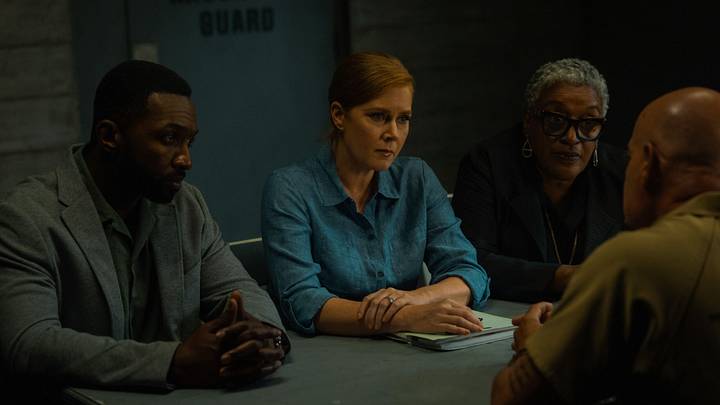
The first two episodes of Cape Fear, which stars Javier Bardem (No Country for Old Men, Skyfall), Amy Adams (Arrival, Sharp Objects). Patrick Wilson (The Conjuring franchise, Watchmen) and a handful of other familiar faces, premiered on Apple TV on June 5; the remaining episodes release weekly on Fridays. It is the third adapted iteration of this story: it was first a novel (written in 1958 and titled "The Executioners") and has twice been made into a movie — first in 1962 and most recently in 1991.
 Add us as a preferred source on Google